Why Strain Identity Matters
Probiotic effects are strain-specific rather than species-specific, so a full strain designation — genus, species and strain code — is
2 September 2026Sodatide
SodaTide® is a capsule-based dietary supplement formulated with a synbiotic blend of prebiotic fibers, resistant starch, and probiotics to support everyday digestive and metabolic wellness. Its formula combines chicory root inulin, potato resistant starch, and probiotic strains including Bifidobacterium infantis, Clostridium butyricum, and Akkermansia muciniphila in a convenient daily capsule.
SodaTide® is a capsule-based dietary supplement designed to support digestive and metabolic wellness with a synbiotic blend. One seller publishes inulin 211 mg, resistant starch 100 mg and a 36 mg probiotic blend. grams. $49–$79 a bottle, 60-day guarantee.
Reviewed by Dr. Priya Raghunathan, PharmD, BCNSP · every claim traced to the page that made it

| Product | Sodatide — metabolic & digestive capsule |
|---|---|
| Format | 30 vegetarian capsules per bottle |
| Serving | 1 capsule daily, morning, before food |
| Days per bottle | 30 — both sellers agree |
| Components | 3, all named |
| Amounts published | Disputed between sellers |
| CFU count | None, from any source |
| Stimulants | None — confirmed by both |
| Price | $49–$79 per bottle |
| Guarantee | 60 days (one seller adds 30-day minimum use) |
| Our rating | 2.4 / 5 |
This is a live-culture product containing fermentable fibre. Gas and bloating in the first week are normal. Inulin is a FODMAP and frequently triggers symptoms in irritable bowel syndrome. And probiotics are not for everyone — anyone immunocompromised, seriously unwell or with a central line should not start one without medical advice. Sudden unexplained weight loss or persistent abdominal pain need a doctor, not a supplement.
It should be the simplest question about a supplement. Two pages sell this capsule, and they give answers that cannot both be true.
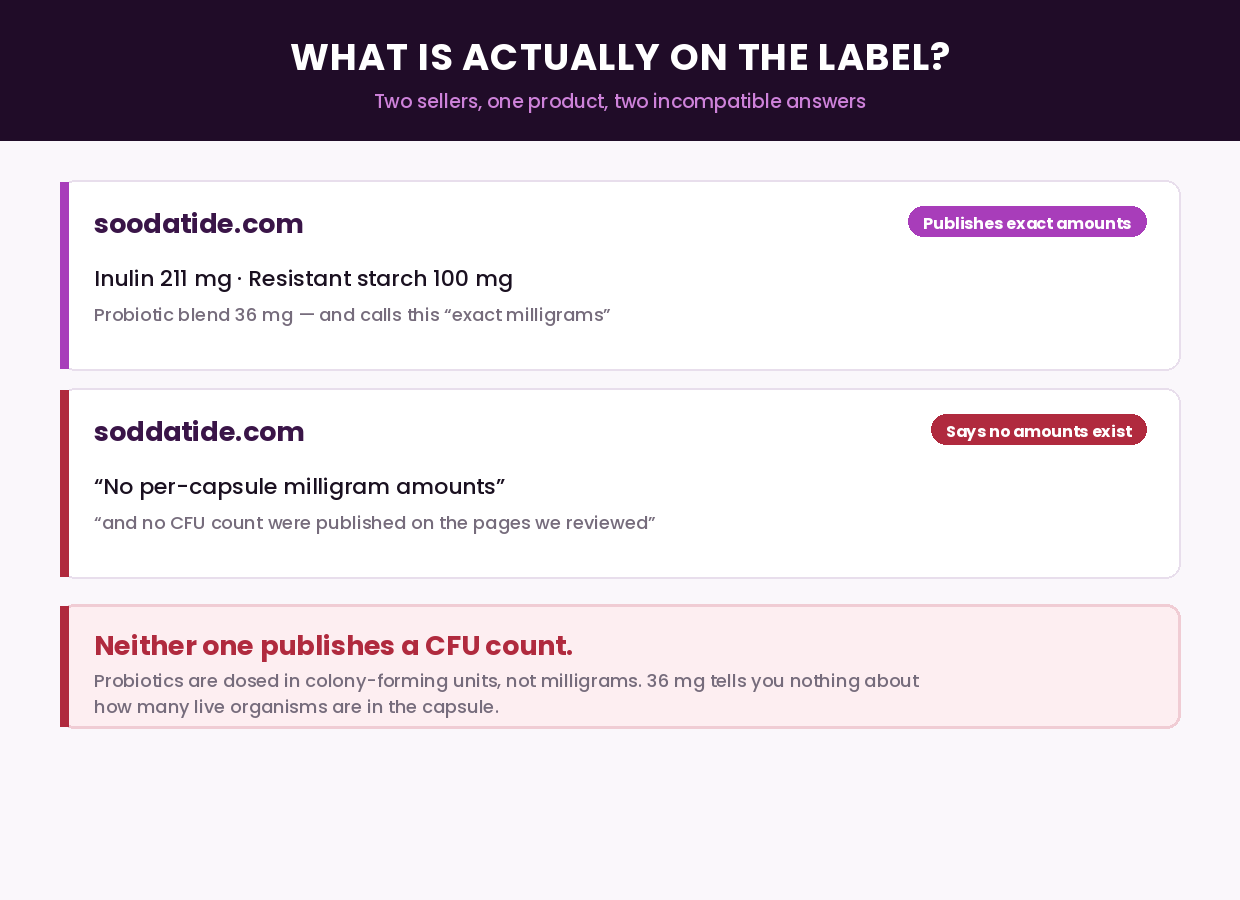
Nobody can tell you from a website. sodatide publishes inulin 211 mg, resistant starch 100 mg and a 36 mg probiotic blend, and calls that exact transparency. sodatide states plainly that no per-capsule milligram amounts and no CFU count were published on the pages it reviewed. Photograph the panel on your own bottle.
States Chicory Root Inulin 211 mg, Potato Resistant Starch 100 mg and a three-strain probiotic blend at 36 mg — 347 mg in total — and makes that transparency a selling point: “every ingredient named with exact milligrams”.
States the opposite in writing: “no per-capsule milligram amounts and no CFU count were published on the pages we reviewed”, and adds “we will not invent a number we cannot read on a label”. It repeats the point in its ingredients section and FAQ.
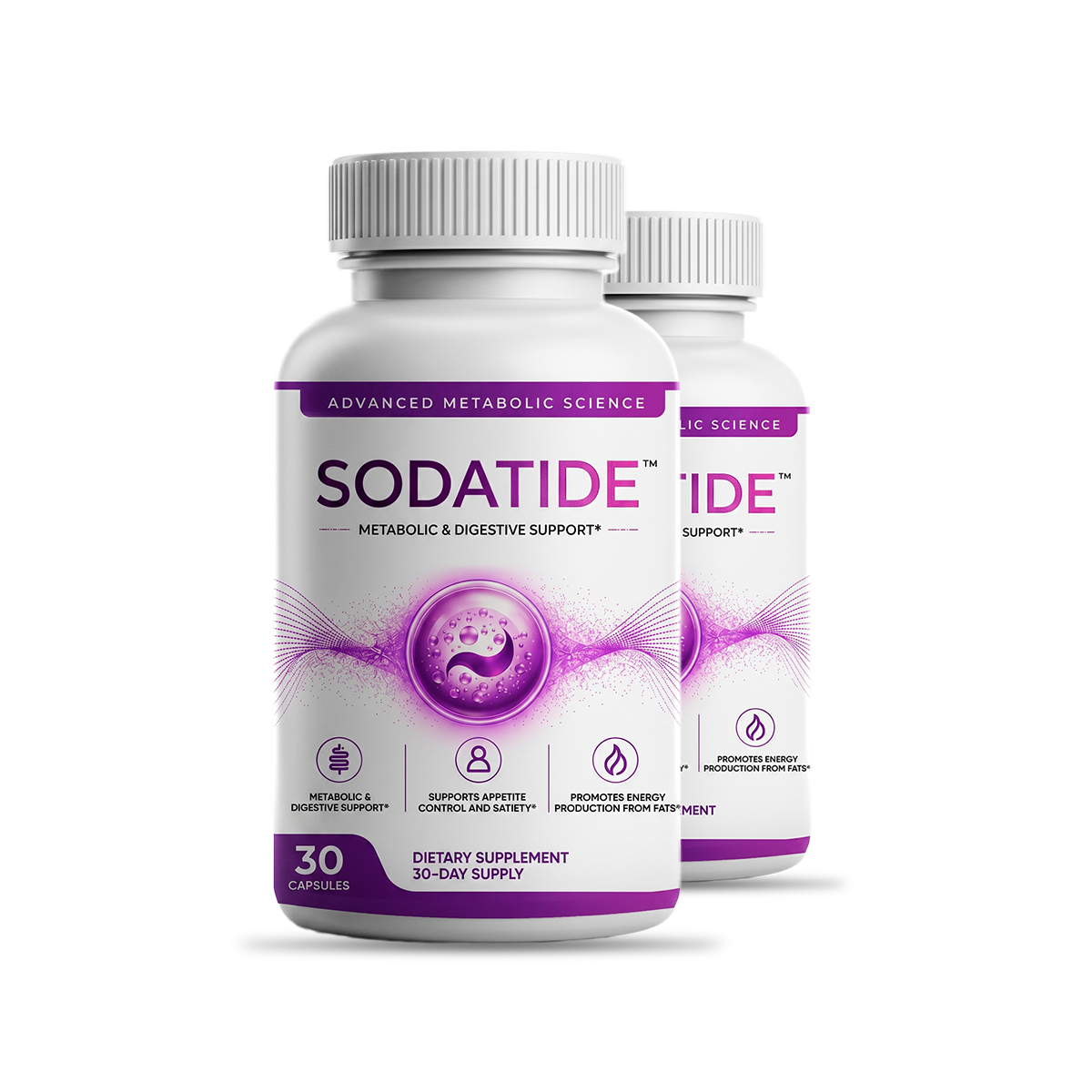
The supplied label states 30 capsules and a 30-day supply, and names the product Metabolic & Digestive Support. Whatever Supplement Facts panel is printed on your bottle is the document that decides which of the two accounts above is correct.
Take the more generous account at face value — assume the milligrams are real. The fibre trials behind these ingredients are measured in grams a day.
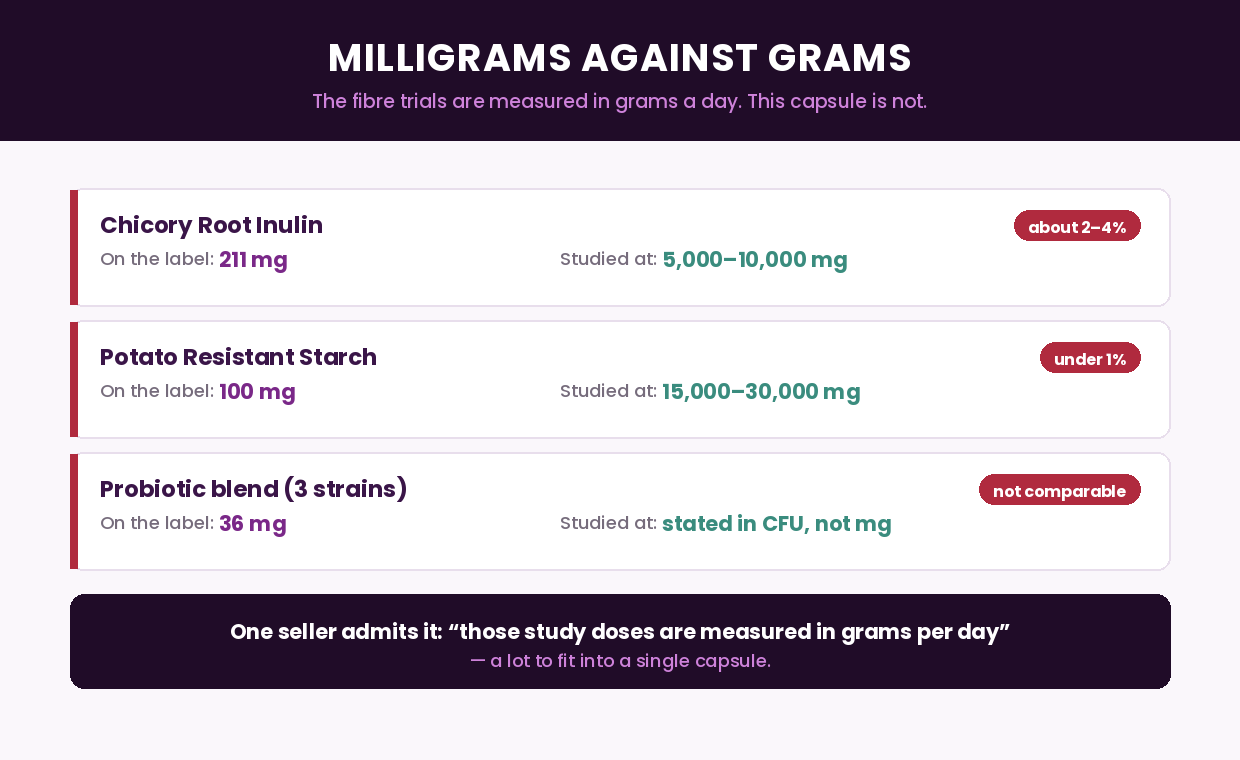
Chicory root inulin. Prebiotic trials use roughly 5–10 grams daily. The published figure is 211 milligrams — about two to four per cent of the low end.
Potato resistant starch. Studied at 15–30 grams daily. The published figure is 100 milligrams, under one per cent.
The probiotic blend. 36 mg tells you the weight of the powder. It does not tell you how many live organisms are in the capsule, and no source states that. Detail on the ingredients page.
| Component | Published amount | What the research used |
|---|---|---|
| Chicory Root Inulin (prebiotic fibre) | 211 mg (per one seller only) | 5–10 g daily; 211 mg is 2–4% of that |
| Potato Resistant Starch (type 2 resistant starch) | 100 mg (per one seller only) | 15–30 g daily; 100 mg is under 1% of that |
| Three-Strain Probiotic Blend (includes Akkermansia muciniphila) | 36 mg (per one seller only) | CFU count not published by any source |
Both present themselves as where you buy Sodatide. Set what they state side by side and the picture is not consistent.
| On this point… | sodatide | sodatide |
|---|---|---|
| Milligram amounts | Inulin 211 mg, starch 100 mg, blend 36 mg | “none published” |
| CFU count | not stated | not stated — says so explicitly |
| Strains named | three named in its mechanism text | one named; “other two not disclosed” |
| Star rating | 4.93 / 5 from 13,000+ reviews | publishes no rating at all |
| Regular price quoted | $79 per bottle | $179 per bottle |
| Free bonuses | 4 digital guides | 6 digital bonuses |
| Side effect statement | “no side effects have been reported” | fibre commonly causes gas in week one |
| Guarantee | 60 days from purchase | 60 days, plus a 30-day minimum use period |
Both pages agree on what you pay: $158, $207 or $294. They disagree entirely on what it is reduced from. One closes by saying the regular price is $79 a bottle. The other builds its whole savings table on $179 a bottle, advertising up to 73% off. Ignore both anchors and judge the real totals.
One of these two pages is unusually honest. It refuses to publish a star rating for a product it cannot test, states that its citations cover ingredient categories rather than the finished capsule, admits the fibre study doses are measured in grams, and says plainly that it is not the manufacturer and earns commission. That is a better standard than most of this category — and the same applies to this page, which is why our disclosure is one click away.
Each claim is taken from the brand's own artwork or the pages selling it, and judged against one question: can it be checked against a published number?
Supported. One vegetarian capsule a day, 30 per bottle, a clean 30-day supply. The label, both sellers and the supplied artwork all agree, and as a habit it is about as easy as this category gets.
Supported. Chicory root inulin, potato resistant starch and a probiotic blend including Akkermansia muciniphila. Naming a specific strain is more than most gut formulas manage.
Supported. There is no caffeine and no thermogenic ingredient here, and that is a real difference from most of the weight-support category. No jitters, no afternoon crash to manage.
Not supported. One seller publishes milligrams and calls it exact transparency. The other states in writing that no per-capsule amounts are published anywhere. They cannot both be describing the same label.
Not supported. Inulin is studied at 5–10 grams daily and resistant starch at 15–30 grams. The published figures are 211 mg and 100 mg — a few per cent and under one per cent of those ranges.
Not supported. Probiotics are measured in colony-forming units. No CFU count is published by the brand or by either seller, so the number of live organisms per capsule is simply unknown.
Not supported. The mechanism is plausible and the research on fibre and the microbiome is real — but it is research at gram doses, and there is no trial of the finished product.
Partly. Both sellers state 60 days. One adds a 30-day minimum use period before you may request a refund, which halves the window in which you can actually decide.
A once-daily capsule, thirty per bottle, a clean 30-day supply. No stimulants at all, which genuinely separates it from most of the weight-support shelf. Three named components, one named strain, vegetarian and lactose-free.
If the amounts matched the research, this would be a product worth recommending.
No CFU count from any source. Two sellers who cannot agree whether milligram amounts exist at all. And where amounts are given, fibre at a few per cent of the doses its research used.
A good mechanism at a token dose is still a token dose.
Sodatide is a once-daily vegetarian capsule for metabolic and digestive support — 30 capsules per bottle, a 30-day supply. It combines two prebiotic fibres with a three-strain probiotic blend including Akkermansia muciniphila, and contains no stimulants. It suits someone wanting a simple gut-focused routine; it does not suit anyone who needs the dose to match the research.
Read as what it is — a small daily dose of prebiotic fibre and live cultures, with no stimulants — Sodatide suits someone who wants an easy gut-focused habit and is not relying on it for a specific outcome. The ingredient choices are sensible and the format is genuinely easy to keep up.
Read as the metabolic and weight-support formula it is marketed as, it does not hold up: the fibre amounts are a fraction of studied doses and the live dose is unpublished. Full detail on what Sodatide is, or see how Sodatide works.


Supplied brand artwork, used as provided with only the “Made with AI” badge removed. Note its first panel — “Boosts Metabolism: Accelerates Calorie Burning” — which is a thermogenic claim on a product both sellers correctly describe as containing no stimulants at all.
Through a real and well-described mechanism, at amounts too small to drive it. Fermentable fibre reaches the colon undigested and is fermented into short-chain fatty acids, which is genuine science — but it is dose-dependent science, studied at grams per day. The live strains add organisms in a quantity nobody publishes.
One vegetarian capsule daily, with a full 8 oz glass of water, in the morning before a meal. Both sellers and the bottle agree on this, which is more than they agree on elsewhere.
Chicory root inulin and potato resistant starch are not broken down in the small intestine. They reach the colon intact, which is the whole point of a prebiotic.
In the colon, bacteria ferment fibre into short-chain fatty acids including butyrate and propionate — the molecules behind most of the published work on satiety hormones and insulin sensitivity. This step is real. It is also dose-dependent.
The probiotic blend adds live organisms, including Akkermansia muciniphila. How many organisms is the question nobody answers, because no CFU count is published.
What each one is, what the research used, and how far the published figure sits from it. Full context on the Sodatide ingredients page.
about 2–4% of the studied dose
On the label: 211 mg (per one seller only) · studied at 5–10 g daily in prebiotic trials
Is 211 mg of inulin a prebiotic dose?
No — and this is the clearest gap in the formula. Inulin research is measured in grams a day; 211 mg is a small fraction of the low end.
under 1% of the studied dose
On the label: 100 mg (per one seller only) · studied at 15–30 g daily in resistant starch trials
What can 100 mg of resistant starch do?
Essentially nothing measurable. Resistant starch is studied at 15 to 30 grams daily — this is under one per cent of the low end.
no CFU count published by anyone
On the label: 36 mg (per one seller only) · studied at stated in CFU, not milligrams
How many live organisms are in a Sodatide capsule?
Nobody says. This is the single most important omission on the label, and it is missing from both selling pages.
Microbiome research runs four to twelve weeks, which is three bottles. The guarantee runs 60 days, and one seller wants 30 days of use before you may claim — so three bottles is the pack that fits both.
See Current Sodatide PricingOfficial website checkout · 60-day guarantee · confirm the terms before paying
Supported: a genuinely easy once-daily habit, a stimulant-free formula, named ingredients including a named strain, and a vegetarian lactose-free capsule. Partly: gut microbiome and digestive support, where the mechanism is right but the dose is small. Not supported: appetite, metabolic and weight claims.
These are supportive wellness statements for healthy adults, not promised outcomes. Each carries the same ruling used in the verdict matrix. More detail on the Sodatide benefits page.

One capsule, once a day, thirty per bottle. No timing protocol, nothing to measure, no second dose to remember. Easy routines get taken; complicated ones get abandoned, and this is the part of the product that works.
No caffeine, no green tea extract, no thermogenic. For anyone who has given up on diet capsules because of jitters or disturbed sleep, that is a real and deliberate difference.
Chicory root inulin, potato resistant starch, and a probiotic blend that names Akkermansia muciniphila specifically. Naming even one strain is more than most gut blends do.
A vegetarian capsule with no dairy carrier, which genuinely widens who can take it. This is checkable and both sellers agree on it.
The mechanism is sound in principle — fermentable fibre feeds resident bacteria, live strains add to them. At 211 mg and 100 mg of fibre, the feeding is a gesture rather than a dose, and no CFU count means the seeding cannot be judged at all.
Fibre and live cultures are the two levers most used for this, so the direction is right. The amounts published are far below what the regularity research uses, and fibre can cause gas before it settles anything.
Fullness signalling from fermentable fibre is a genuine research area, at gram-level doses that slow gastric emptying. A few hundred milligrams does not do that.
This is what the product is sold on. There is no trial of the finished capsule, the fibre amounts are a fraction of studied doses, and the probiotic dose is unpublished.
It is the only document that settles whether the milligram amounts one seller publishes are actually printed — and whether a CFU count exists at all. Look for a figure stated at expiry, not at manufacture.
Read as a small daily fibre-and-cultures habit, Sodatide is reasonable. These steps keep it that way and stop you paying for a dose that is not there.
This matters more here than with most products. One seller says the amounts are printed; the other says they are not published anywhere. The panel on the bottle you receive settles it, so photograph it the moment it arrives.
A probiotic is measured in colony-forming units. If the panel gives only milligrams for the blend, you still do not know how many live organisms you are taking — and ideally the figure should be stated at expiry, not at manufacture.
One capsule with a full glass of water, at the same time daily. Consistency matters more than the exact hour, and a habit attached to breakfast is the one most people keep.
Both sellers ask for this, and it is a genuine live-culture instruction rather than a flourish. Keep it sealed and out of direct sunlight before opening too.
Fermentable fibre does this while the gut adjusts. Both sellers say so — although one of them also claims no side effects have been reported, which cannot both be true.
Onions, garlic, oats, beans, cooled potatoes and rice. The gap between 211 mg and the 5–10 g used in research is closed by lunch, not by a second capsule.
Live-culture supplements are not for everyone. Anyone immunocompromised, seriously unwell, or managing a diagnosed gastrointestinal condition should ask before starting.
One seller requires 30 days of use before a refund request and closes the window at 60. That leaves a narrow band in the middle — mark it in your calendar on the day you order.
Two bottles at $79 each ($158 plus shipping), three at $69 each ($207, free shipping) or six at $49 each ($294, free shipping). The Sodatide discount is applied by bundle size rather than a coupon code, and there is no single-bottle option.

What you pay is the same on both: $158, $207 or $294. What it is reduced from is not. One page's closing call to action states a regular price of $79 a bottle — which would make the two-bottle pack no saving at all. The other builds its entire savings table on $179 a bottle and advertises up to 73% off. Both cannot be the regular price of the same capsule. Ignore the crossed-out figures and compare the real totals, which do agree.

Sixty days from purchase, per both selling pages — but one requires 30 days of use first, which halves your real decision window. The six-bottle bundle is 180 days of product, so most of it sits outside the guarantee either way.
Both sellers state a 60-day money-back guarantee from the date of purchase. As a policy that is reasonable and we have no criticism of the wording itself.
One of them adds a condition the other does not mention: you are asked to use the product for at least 30 days before requesting a refund. Read those two terms together and the window in which you can actually decide is roughly day 30 to day 60 — and return postage eats the end of it. Screenshot the terms with the date, and set a reminder for day 50.
Check the Guarantee Terms



Badges describe manufacturing procedures and stated policies. None of them tells you how much of anything is in the capsule, and none tells you how many live organisms it delivers. No dietary supplement is FDA-approved — an FDA-registered facility means the site is on file with the agency, which is paperwork rather than endorsement. To their credit, both selling pages state this distinction correctly.
One seller advertises 4.93/5 across 13,000+ reviews; the other declines to publish any rating for a product it cannot test. Our own assessment is on the Sodatide review page.

"Easy capsule, no jitters, which is why I picked it over the caffeine ones. Bloated for about five days at the start, then fine. Can't say more than that."

"I wanted the CFU number before ordering and couldn't find it on either site. Emailed support, got a friendly reply that didn't answer it. Ordered anyway, still don't know."

"Got the six pack. Only later realised it says refrigerate after opening — that's a lot of months for the last bottle to sit around before I get to it."
The common effect is gas or bloating in the first week, which is what fermentable fibre does while the gut adjusts. Inulin is a FODMAP and often triggers IBS symptoms. Live cultures are not suitable for anyone immunocompromised or seriously unwell. And with no CFU count published, the live dose cannot be assessed by anyone.
This is the most common experience with any inulin-containing product, and both sellers mention it. Gas, bloating and changes in bowel habit in the first week are normal as the gut adjusts. What is odd is that one of the two pages also states that no side effects have been reported when used as directed — on the same page that warns about bloating five times over.
Inulin is a fermentable oligosaccharide, which places it among the FODMAPs that commonly trigger symptoms in irritable bowel syndrome. If you follow a low-FODMAP approach or have diagnosed IBS, this is an ingredient to raise with your clinician rather than trial blind.
Probiotic supplements are not appropriate for everyone. People who are immunocompromised, critically unwell, or have a central venous catheter face a genuine if uncommon risk of infection from live organisms, and should not start one without medical advice.
With no CFU count published by the brand or either seller, neither you nor a pharmacist can judge how many organisms a capsule delivers. For most healthy adults that is a value problem rather than a safety one, but for anyone in the group above it is a reason to ask before taking it.
Both sellers ask you to refrigerate after opening, which is what live cultures require. It sits awkwardly against a heavily promoted 180-day bundle that spends months in storage and transit before you open the last bottle.
Sodatide is a dietary supplement and not a treatment for obesity or for any diagnosed metabolic or digestive condition. Sudden unexplained weight loss, persistent abdominal pain, or blood in the stool are symptoms for clinical assessment, not for a capsule.
Short, specific answers to what buyers search before ordering from the Sodatide official website — including the ones where the honest answer is that the sources contradict each other.
Check Price & AvailabilitySodatide is a once-daily vegetarian capsule for metabolic and digestive support: 30 capsules per bottle, a 30-day supply. It names three components — chicory root inulin, potato resistant starch and a three-strain probiotic blend including Akkermansia muciniphila — and it contains no stimulants.
The three components are named consistently. The amounts are not. One seller publishes inulin 211 mg, resistant starch 100 mg and a 36 mg probiotic blend. The other states in writing that no per-capsule milligram amounts were published on the pages it reviewed. Check the panel on your own bottle.
No CFU count is published by the brand or by either page selling it. That is the most important gap on this label: probiotics are dosed in colony-forming units, so a milligram figure for the blend tells you the weight of the powder, not how many live organisms you are taking.
No. Prebiotic trials on chicory root inulin use roughly 5 to 10 grams daily, so 211 mg is about two to four per cent of the low end. Resistant starch is studied at 15 to 30 grams; 100 mg is under one per cent.
One capsule daily with a full 8 oz glass of water, in the morning before a meal. Both sellers also ask you to refrigerate the bottle after opening, because live probiotic cultures keep better cold.
The common one is gas or bloating in the first week, which is what fermentable fibre does while the gut adjusts. Note that one selling page claims no side effects have been reported while warning about bloating repeatedly on the same page.
There is no clinical trial of the finished product, and both sellers say their citations cover the ingredient categories rather than the capsule. Given that the fibre amounts are a few per cent of studied doses and the probiotic dose is unpublished, a measurable weight effect is not something the label supports.
Two bottles at $79 each ($158 plus shipping), three at $69 each ($207, free shipping), or six at $49 each ($294, free shipping). Note the sellers quote different regular prices: $79 a bottle on one page and $179 on the other.
Both state 60 days from purchase. One adds that you must use the product for at least 30 days before requesting a refund, which leaves a narrower decision window than it first appears. Screenshot the terms on the page you buy from.
Microbiome research usually runs four to twelve weeks before measuring anything, and both sellers say to judge it over weeks rather than days. That is fair — though it sits against a 60-day guarantee with a 30-day minimum use period.
Both sellers instruct buyers to refrigerate the bottle after opening, which is standard for live cultures. It is worth weighing against the six-bottle bundle, where the last bottle may be opened five months after it arrives.
No dietary supplement is. Both sellers correctly describe an FDA-registered facility, which means the manufacturing site is on file with the agency — a paperwork fact, not an endorsement of the product.
Through the official checkout so the stated guarantee attaches to your order. Both pages that present themselves as the place to buy carry affiliate disclosures, and neither is the manufacturer.
Our rating is 2.4 out of 5. The format is genuinely good, the ingredients are sensibly chosen and it is honestly stimulant-free. But the two sellers cannot agree whether any amounts are published, the fibre figures that do exist are a fraction of studied doses, and no CFU count exists anywhere.
Probiotic effects are strain-specific rather than species-specific, so a full strain designation — genus, species and strain code — is
Credit the design decisions, mark down the doses, and land below average.
Four disclosure changes that cost nothing, and one reformulation that costs the format.
Live cultures decline over shelf life, so a count guaranteed at expiry is a far more meaningful figure than one measured at the moment
A colony-forming unit is one viable organism capable of multiplying, and CFU is the unit probiotic doses are measured in — typically in
Nine checks, fifteen minutes, and almost every common complaint never happens to you.
You now have what each seller states about the label, the published amounts against the doses their research used, the missing CFU count, the two different regular prices, the 30-day minimum before a refund, and the refrigeration instruction set against a 180-day bundle. That is more than either page will give you.
If a small daily fibre-and-cultures habit is what you want — judged as that, with no expectation you cannot verify — three bottles covers the four to twelve weeks microbiome research uses. From $49 per bottle · free US shipping on 3 and 6 · 60-day money-back guarantee.
Claim Your Sodatide Discount